
Consumer Devices and Home Networking
IoT and Connected Consumer Electronics
Consumers expect their network-enabled devices to easily discover, join and fully interoperate with the networks available in the environments around them. The UPnP Forum and DLNA provide open frameworks to allow control devices, applications and many types of servers to discover, configure and control devices on a local network. Allegro’s RomPlug suite of development toolkits enables engineering teams with flexible and robust tools to create state of the art UPnP and DLNA connected consumer electronics and mobile devices. Engineers save significant time, effort and money by using Allegro’s proven and stable implementations of UPnP and DLNA industry standard protocols.
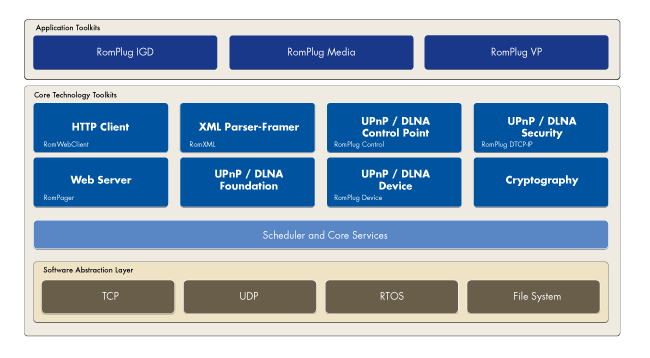
Click on the image to enlarge
RomPlug® UPnP-DLNA Core Toolkits
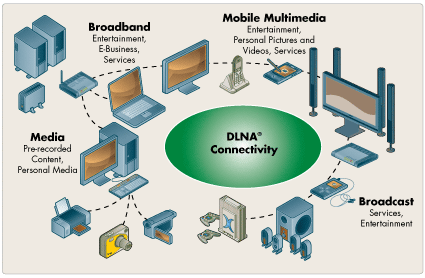
Click on the image to enlarge
RomPlug® Device
RomPlug® Control
Click on the image to enlarge
Application Toolkits:
RomPlug® UPnP-DLNA Application Toolkits
RomPlug® MediaPlay Toolkit
- API to retrieve and parse device and service descriptions
- API for event subscriptions
- Flexible framework to create a DMP that complies with DLNA DMP guidelines
RomPlug® MediaServe Toolkit
- Serves device and service descriptions without application interactions
- Event subscriptions are initiated and renewed without application interaction
- State variable changes are automatically communicated to control points transparent to the application
- Toolkit provides a rich API for device specific actions
RomPlug® MediaRender Toolkit
- Serves device and service descriptions without application interactions
- Many Control Point actions handled by the toolkit without application interaction
- Toolkit provides a rich API for device specific actions
- DMR easily complies with DLNA DMR guidelines
- DMR supports Microsoft “Play To” capabilities
RomPlug® MediaControl Toolkit
- API to retrieve and parse device and service descriptions
- API for event subscriptions
- Event messages are automatically parsed and passed to the application
- Extremely flexible with API for device specific actions
RomPlug® VP Toolkit
- Fully integrated with UPnP/DLNA protocols
- Integrated framework
- HTML5/RUI support
- Diagnostic (DIAG) support
- Authentication (AUTH) support
RomPlug DTCP-IP™ Toolkit
- Fully compliant implementations of DTLA DTCP-IP
- Routinely qualified at ongoing industry interoperability plug fests
- Fully integrated with the RomPlug® suite of products
RomPlug® IGD Toolkit
- API for service action events (Layer 3 forwarding, WAN Configuration, etc.)
- Evented variables automatically communicated to subscribers
- Flexible framework for creating IGD products

Understanding the Impact of Open-Source Software on IoT Device Security
Open-source software (OSS) plays a foundational role in modern development environments. Its accessibility, speed, and cost-efficiency make it a popular choice among IoT device manufacturers, especially those racing toward aggressive timelines and tight budgets. But...

The Future of IoMT Security and the Battle to Protect Healthcare Data
Healthcare data is under attack. Learn how to strengthen your IoMT security with encryption, access controls, and embedded device protection.

FIPS Validation: The Key to Medical Device Security
FIPS validation is crucial for securing medical devices, a key concern for healthcare technology. Get key insights on IoMT requirements for implementing cryptography and more on Embedded Computing Design. This insightful article delves into the importance of adhering...
Let’s Talk IoT Security
Implementing IoT device security can be a challenge. Let us help you by sharing our proven framework for integrating a proactive security approach into your design. Click the button below to schedule a one-on-one web conference to discuss your security needs.

[gravityform id="11" title="false" description="false"]